Manufacturing in U.S. Unexpectedly Contracted in June

Manufacturing in the U.S. unexpectedly shrank in June for the first time since the economy emerged from the recession three years ago, indicating a mainstay of the expansion may be faltering.

The Institute for Supply Management’s index fell to 49.7, worse than the most-pessimistic forecast in a Bloomberg News survey, from 53.5 in May, the Tempe, Arizona-based group’s report showed today. Figures less than 50 signal contraction. Measures of orders, production and export demand dropped to three-year lows.


Treasury yields fell on concern Europe’s debt crisis and a slowdown in Asia are taking a bigger toll on the world’s largest economy and hurting manufacturers like DuPont Co. (DD) and Steelcase Inc. (SCS) Assembly lines are at risk of slowing further as consumers temper purchases and companies cut back on investment.

“Manufacturing is gearing down,” said Neil Dutta, head of U.S. economics at Renaissance Macro Research LLC in New York, whose 50.5 forecast was the lowest in the Bloomberg survey. “It’s consistent with the idea that the uncertainty is weighing on businesses. Europe is taking a bite out of the export sector.”

The yield on the benchmark 10-year Treasury note declined to 1.59 percent from 1.65 percent on June 29. The Standard & Poor’s 500 Index erased earlier losses after last week capping its best June rally since 1999. The S&P 500 climbed 0.3 percent to 1,365.51 at the close in New York.

The ISM index, which dropped to its lowest level since July 2009, was less than the median forecast of 52 in the Bloomberg survey. Estimates of 70 economists ranged from 50.5 to 53.5. The gauge averaged 55.2 in 2011 and 57.3 the prior year.
No Recession

Today’s reading is well above the 42.6 level that generally indicates the economy as a whole is expanding, according to ISM.

“We are not yet in recession territory,” Nigel Gault, chief U.S. economist at IHS Global Insight in Lexington, Massachusetts, said in an e-mail to clients. “Recessions are usually accompanied by ISM readings in the low-40s. And the construction news is improving, while consumers are being helped by tumbling gasoline prices.”

A separate report today from the Commerce Department in Washington showed the improvement in the housing market helped boost construction spending in May to the highest level in two years. Housing demand has shown a gradual recovery. Purchases of new houses rose 7.6 percent in May to reach the highest level since April 2010, recent data showed.

Manufacturing is also weaker in the rest of the world. The industry in the euro-area contracted for an 11th straight month in June as Europe’s debt crisis sapped demand. A measure of the region’s factories held at 45.1, London-based Markit Economics said.
Europe’s Economy

Euro-area unemployment reached the highest on record in May, other figures showed. The jobless rate in the 17-nation region rose to 11.1 percent, the highest since the data series began in 1995, from 11 percent a month earlier, the European Union’s statistics office in Luxembourg said.

A manufacturing purchasing managers’ index for China fell to 48.2 in June from 48.4 a month earlier, HSBC Holdings Plc and Markit said today.

The ISM’s U.S. production index decreased to 51, the lowest since May 2009. The new orders measure dropped to 47.8, the weakest since April 2009, from 60.1. The drop in demand from the previous month was biggest since October 2001, after the September 11 terrorist attacks.

The employment gauge decreased to a three-month low. The index of prices paid decreased to 37 from 47.5.

Manufacturing accounts for about 12 percent of the economy and has been at the forefront of the recovery that began June 2009.
Jobless Rate

Slower hiring and an unemployment rate exceeding 8 percent may keep restraining household spending, which accounts for about 70 percent of the economy. Cars and light trucks sold at a 13.7 million annual rate in May, the weakest this year and down from April’s 14.4 million pace, Ward’s Automotive Group data showed.

Executives at Wilmington, Delaware-based DuPont said while growth in North America is holding up, the third-largest U.S. chemical maker is concerned about a slowdown in China and Germany’s dependence on exports.

“My number one worry is what will happen in Europe over the next six to nine months,” Diane Gulyas, group vice president of DuPont’s performance-materials segment, said on a conference call with analysts on June 14.
Steelcase Sales

Steelcase, a Grand Rapids, Michigan-based maker of office furniture, said first-quarter sales fell in most major markets in the region that includes Europe, Middle East and Africa.

“Uncertainty in the global economy continues to take its toll on specific parts of our business,” Chief Financial Officer David Sylvester said on a conference call on June 21.

The U.S. economy expanded 1.9 percent in the first quarter, the same as previously estimated and following a 3 percent pace in the prior three months, revised data showed last week.

To combat flagging growth, Federal Reserve policy makers said they are ready to take more steps should the U.S. expansion slacken.

Fed officials said in a policy statement on June 20 that they expect “economic growth to remain moderate over coming quarters and then to pick up very gradually.”

From : Bloomberg
 

El-Erian: Will Europe Amplify or Lessen Investors' July 4th Celebrations?

Expect heated discussions around some July 4th barbeques in the US - not just on the economy, elections and last week's Supreme Court ruling, but also on the follow-through to Friday's impressive surge in equity markets around the world.

Some see the trigger - the European summit - as lifting the dark clouds that have dampened investor enthusiasm and pose an "existential risk" for the euro area. Others remain skeptical, welcoming the better-than-expected outcome but characterizing it as insufficient over time.

Where investors end up on this spectrum boils down to whether they believe that European policy incrementalism can accumulate quickly into a beneficial tipping point; and this week will provide important insights on this. Let me explain.

It is highly significant that government leaders have evolved to the explicit pursuit of three major strategic initiatives that would place the eurozone's architecture in a much better place: namely, supplementing monetary union with fiscal union, banking union and greater political integration.

It is also significant that, by modifying regional crisis management mechanisms (and the ESM in particular), they understand the urgent need to break the vicious feedback loop between weak banks and deteriorating sovereign creditworthiness.

Unfortunately, government leaders are still falling short of the required policy breakthrough.

The policy timetable is still too timid given conditions on the ground, and the operational procedures too cumbersome. Funding lines for the emergency facilities remain partial and divergent national political narratives can confuse things (including statements over the weekend out of Finland, Germany and the Netherlands).


So, for the risk-on phase to build adequate momentum, Europe needs to add to its policy progress and also minimize headwinds. Over the next few days, investors will receive three important indicators on this.

First, investors will learn on Thursday whether last week's summit provides sufficient air cover for the ECB [cnbc explains] not just to cut its 1% benchmark rate by 25 to 50 basis points but also to support peripheral bonds (through the reactivation of the bond purchase program (SMP), another LTRO , or a new mechanism). It is not clear whether the central bank's governing council is there yet.

Second, they will monitor the resumption of negotiations between the Greek government and the Troika (consisting of the ECB, EU and IMF) - a complicated affair, especially as the assumptions underpinning prior agreements have been overtaken by unfavorable economic and financial developments. It is not clear who would put up the money to compensate for both this and for the new government's electoral commitment to stretch out the pace of domestic economic adjustment.

Lastly, Friday's monthly employment report out of the US will have an impact, and especially so after Monday's disappointing (ISM) manufacturing numbers.

For Europe to minimize external headwinds, the US needs both to avoid another sub-100,000 job creation print and to deliver improving indicators of long-term unemployment and labor force anticipation. Absent that, joblessness will again become a substantial leading indicator (and not just a lagging one), dampening consumer confidence, spending and companies' investment in plant and equipment - all of which would worsen employment prospects.

This week's July 4th holiday in the US will feature the traditional and enjoyable mix of parades and picnics, culminating with fireworks across the country. Throughout, investors will anxiously hope for additional policy measures, particularly out of Europe, that enable them to breathe easier and perhaps even add to their celebrations.

From CNBC
 

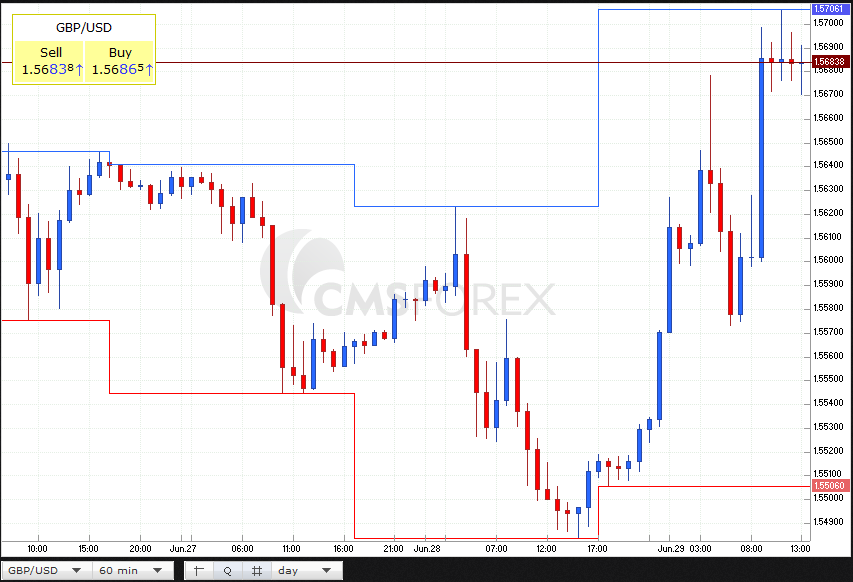
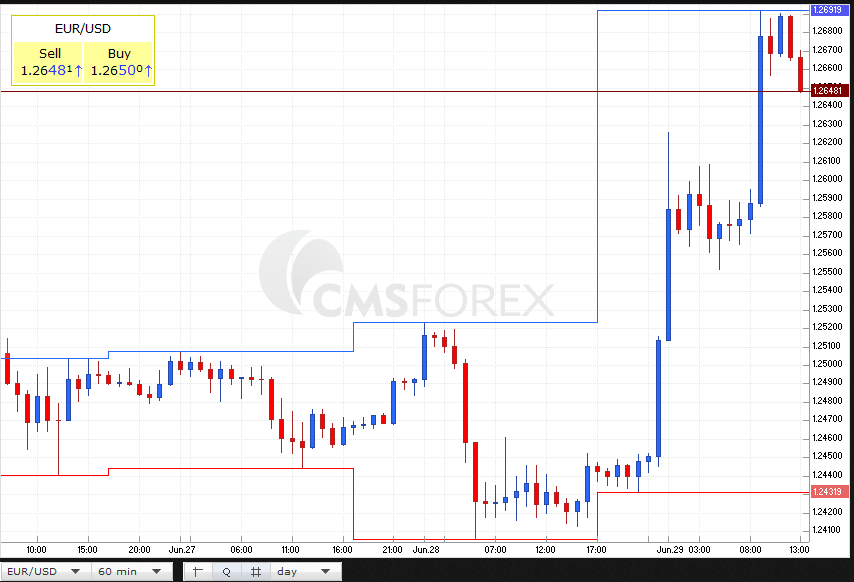
Forecast EURUSD 02-07-2012 Trend Down

Forecast EURUSD 02-07-2012 Trend Down


Barclays Chairman Said to Be Poised to Resign After Libor Fine


Barclays Plc (BARC) Chairman Marcus Agius plans to resign after the bank was fined a record 290 million pounds ($455 million) for trying to rig interest rates, sparking a political outcry, according to a person briefed on the matter.

An announcement may come as soon as today, said the person, who asked not to be identified because the move hasn’t been made public. Agius, 65, has been chairman of Britain’s second-largest bank by assets since January 2007.

He is the most senior executive to offer to step down following probes by global regulators into whether lenders colluded to manipulate Libor. Chief Executive Officer Robert Diamond remains under pressure from lawmakers after U.K. and U.S. regulators found the lender “systematically” attempted to rig the London and euro interbank offered rates for profit.

“Politicians will see this as him taking a bullet for Bob Diamond,” said Christopher Wheeler, a London-based banking analyst at Mediobanca SpA. “They realized they needed to do something, and Agius was chairman during the time they got fined for -- but will it be enough?”

Both Diamond and Agius have been called to appear this week before British lawmakers on the Treasury Select Committee. Separately, the U.K. government is preparing an inquiry into the future of Libor, including introducing criminal penalties for people who breach rules surrounding the rate, said a Treasury spokesman, who declined to be named citing government policy.
David Cameron

Prime Minister David Cameron on June 28 called for accountability to go “all the way to the top,” while opposition Labour Party leader Ed Miliband has called for a full inquiry into the industry’s practices.

Barclays has tumbled 17 percent since the fine was announced on June 27, making it this year’s worst performer in the five-member FTSE 350 banks index.

Diamond, who built up and ran the securities unit during the period being probed by regulators, may keep his job because he has no obvious successor, according to Chirantan Barua, an analyst at Sanford Bernstein Research in London. None of the bank’s largest shareholders have publicly called for Diamond’s resignation so far.

“Shareholders will be worried that if Bob goes, the stock may go down another 10 percent,” Wheeler said.

Diamond, 60, his three top lieutenants, Chief Operating Officer Jerry del Missier, Finance Director Chris Lucas and corporate and investment banking chief Rich Ricci have already forfeited their bonuses for this year following the fines.
Michael Rake

Agius is likely to be replaced by Michael Rake, Sky News reported yesterday. Rake, 64, is chairman of BT Group Plc and has been a director of Barclays since 2008. Officials at Barclays declined to comment.

Agius joined Barclays after a 34-year career at Lazard Ltd., where he had been chairman of the firm’s London unit. There, he advised on banking takeovers including Halifax Group Plc’s 2001 merger with Bank of Scotland to create HBOS Plc. As non-executive chairman of BAA Plc, Agius helped the owner of London’s Heathrow airport negotiate a higher takeover price from Grupo Ferrovial SA in 2006.

He had already faced investor pressure when the lender raised more than 5 billion pounds in 2008 from a group of funds from Abu Dhabi and Qatar without giving existing shareholders the opportunity to buy new stock. Shareholders including Legal & General Group Plc complained at the time their pre-emption rights had been ignored, and in protest about 16 percent of investors opposed Agius’s re-election as chairman in April 2009.
BBC, BBA

He also had to apologize to shareholders for failing to communicate the firm’s pay plans to investors clearly in April after 27 percent of shareholders voted against Diamond’s 12 million-pound compensation package.

Agius is also a board member of the British Broadcasting Corp. and chairman of the British Bankers’ Association, the industry lobby group that oversees Libor.

Libor is determined by about 18 banks’ daily estimates of how much it would cost them to borrow from one another for different time frames and in different currencies. Because banks’ submissions aren’t based on real trades, the potential exists for the benchmark to be manipulated by traders.

At least a dozen firms, including Citigroup Inc., Royal Bank of Scotland Group Plc and UBS AG, are being probed by regulators worldwide for colluding to rig the rate, the benchmark for more than $360 trillion of securities, including mortgages, student loans and swaps.
False Submissions

Barclays traders routinely coordinated with counterparts from at least four other banks in an attempt to move interest rate benchmarks, according to documents released on June 27 by the U.S. Commodity Futures Trading Commission, the U.S. Justice Department and the U.K. Financial Services Authority.

Derivatives traders requested the false submissions in the Libor and Euribor setting process, as they were “motivated by profit and sought to benefit Barclays’ trading positions,” the U.K. Financial Services Authority said.

Andrew Tyrie, the chairman of Parliament’s Treasury committee, said Diamond will have to answer questions about who profited from the firm’s false submissions and who at Barclays knew about them, according to an interview with the Daily Mail.

“There appear to have been at least two motives for the rigging of Libor,” Tyrie was cited as saying in the interview. “The first was to enable traders to make a profit. The second was to support share prices at a crucial time -- and that is something that might reasonably be considered the responsibility of the relevant companies as a whole.”

SFO Probe?

The U.K. Serious Fraud Office is considering whether to open a formal investigation, its spokesman said last week. The U.S. Justice Department is conducting its own criminal probe into the attempted manipulation of interbank offered rates.

FSA Chairman Adair Turner said yesterday the Barclays fine shows regulator needs more powers to bring criminal charges.

“Further steps were made a few years ago to give us the ability to bring criminal charges in particular areas of market abuse, but they did not cover the Libor market,” Turner said in an interview on the British Broadcasting Corp.’s “Andrew Marr Show.” “We now have to look further and see whether we should strengthen these powers considerably.”

From Bloomberg
 

Linde to Buy Lincare Holdings for $3.8 Billion in Stock

Linde AG (LIN) agreed to acquire Lincare Holdings Inc. (LNCR) for about $3.8 billion to add U.S. oxygen and respiratory therapy services delivered to the home.

Linde will pay $41.50 a share for the company, the Munich, Germany-based producer of industrial and medical gases said in a statement yesterday. That’s 22 percent more than Clearwater, Florida-based Lincare’s closing price on June 29 and 64 percent more than the price on June 26, before the Financial Times’ FT Alphaville reported on talks between the companies.

Chief Executive Officer Wolfgang Reitzle has identified health care as a growth area for Linde and in January agreed to buy Air Products & Chemicals Inc. (APD)’s home-care business. The Lincare purchase will almost triple Linde’s home-care gas sales in the U.S. The medical-gas market will probably grow 50 percent to 16 billion euros ($20 billion) by 2020, according to Linde.

The total price is $4.6 billion including about $800 million in assumed debt, said Matthias Dachwald, a spokesman for Linde. The transaction will be paid for mainly with a $4.5 billion loan that will be refinanced through debt and equity issuances, Linde said. The company said it expects to complete the transaction in its fiscal third quarter.
Industry Consolidation

The Lincare purchase is Linde’s biggest since it bought BOC Group Ltd. in 2006 for 8.93 billion pounds ($13.9 billion). That acquisition trimmed to four the number of larger industrial gas companies, making further consolidation possible only in specialty areas.

Linde generated about 18 percent of its 300 million euros in home-care sales from the Americas last year. Analysts estimate Lincare sales will increase 10 percent this year to $2.04 billion, according to data compiled by Bloomberg.

The biggest competitors in the U.S. home respiratory market for Linde will be smaller, independent firms. Lincare was the biggest with 26 percent of the 2009 respiratory market, followed by Apria Healthcare Group Inc., Rotech Healthcare Inc. (ROHI), and American Homepatient Inc., according to a 2010 presentation by Rotech.

Apria is owned by the private-equity firm Blackstone Group LP, and Highland Capital Management LP owns American Homepatient.

The transaction reunites two distant corporate cousins after almost a century apart. Carl von Linde, who founded his German firm in 1879, created a related U.S. company known as Linde Air Products with partners in 1907, according to a history of Linde on the company’s website. Union Carbide Corp. acquired the U.S. operation in 1917. It later created a unit called Linde Homecare Medical Systems, subsequently shortened to Lincare.

Union Carbide sold Lincare to a group of investors in 1990, and they sold shares to the public in 1992.

From Bloomberg
 

Dell Said to Near Buying Quest to Gain Data-Center Software

Dell Inc. (DELL) is near an agreement to buy Quest Software Inc. (QSFT), a maker of programs to manage corporate computer systems, prevailing in a bidding contest with Insight Venture Partners, people with knowledge of the matter said.

The acquisition may be announced as soon as tomorrow, said the people, who spoke on condition of anonymity because the talks are private. Aliso Viejo, California-based Quest said last week that it received an offer for $27.50 a share, or about $2.32 billion, from a company that it didn’t identify. Dell is that company, the people said.


The purchase would cap a months-long bidding war for Quest and fits with Dell’s aim to add technology that helps customers outfit data centers for handling storage and cloud computing. Quest’s software lets companies administer databases and servers, as well as back up information and recover lost data.

Several companies made offers for Quest since it said on March 8 that it had agreed to be bought by Insight Venture Partners, a private equity firm, for about $2 billion, or $23 a share. Earlier talks between Dell and Quest about an acquisition broke down, a person with knowledge of the matter said June 1.

Quest shares rose less than 1 percent to $27.81 on June 29 and have surged 50 percent this year amid speculation that another company might top Insight’s earlier bid. Dell, the world’s third-largest PC maker, climbed 4.7 percent to $12.51 on June 29. The shares have declined 14 percent this year.

Kelly McGinnis, a spokeswoman for Dell, didn’t immediately respond to a request for comment. Quest spokesman Tom Johnson declined to comment.
Software Takeovers

There have been 530 takeovers of U.S. software companies announced so far this year, according to data compiled by Bloomberg, on pace to break the record 923 transactions set last year. The largest is SAP AG’s planned $4.3 billion acquisition of Sunnyvale, California-based Ariba Inc., announced in May.

Dell told analysts at a June 13 meeting that it plans to use deals to boost revenue from data-center hardware, software and services by 45 percent to $27.5 billion by fiscal 2016, reducing the company’s reliance on the slow-growing desktop and notebook computer businesses.

The last time Dell engaged in a public takeover fight was in 2010, when it lost storage company 3Par Inc. to Hewlett- Packard Co. (HPQ), which bought it for $2.35 billion. That 18-day bidding contest tripled 3Par’s market value.

Michael Dell, founder of the Round Rock, Texas-based company, told Bloomberg News last year that Hewlett-Packard overpaid for 3Par, and he made the right decision in dropping out of the process.

Insight first invested in Quest in 1999 and was the company’s largest institutional investor at the time of its IPO that year, according to a regulatory filing at the time. Insight co-founder Jerry Murdock also served on Quest’s board of directors.


From bloomberg
 

Bristol-Myers to Buy Diabetes Maker Amylin for $5.3 Billion

Bristol-Myers (BMY) Squibb Co., which failed to get U.S. approval for a new diabetes treatment in January, will pay $5.3 billion for Amylin Pharmaceuticals Inc. (AMLN), the maker of two drugs on the market for the disease.

The purchase comes a month after Bristol’s top seller, the blood-thinner Plavix with $7.1 billion in sales last year, began facing generic competition. In 2013, the New York-based company loses patent protection on its $1.6 billion HIV drug, Sustiva.

Under the agreement announced yesterday, Bristol-Myers will pay $31 a share in cash, a 10 percent premium to the June 29 closing price for San Diego-based Amylin. At the same time, AstraZeneca Plc (AZN), based in London, will pay Bristol $3.4 billion to help develop Amylin’s drug portfolio, the companies said.

It “looks a bit rich in terms of the price paid and it’s a trend in the sector, where biotech companies are commanding significant premiums, higher than they would have commanded in previous years because the pharmaceutical sector is being forced down this road,” said Navid Malik, an analyst with Cenkos Securities Plc (CNKS) in London.

The pharmaceutical industry lost patent protection on products valued at $34 billion in annual sales last year, and revenue at risk from generics will rise to $147 billion by 2015, according to data compiled by Bloomberg.

The diabetes market has become a key target for drugmakers as a result of rising obesity rates and the aging of the Baby Boom generation. About 346 million people globally have diabetes, and the number of deaths from the chronic disease may double from 2005 to 2030, according to the World Health Organization.
Other Offers

AstraZeneca, Paris-based Sanofi (SAN) and Merck & Co. (MRK), of Whitehouse Station, New Jersey, also made offers during a bidding process, people with knowledge of the process had said.

Amylin ended a marketing deal with Indianapolis-based Eli Lilly & Co. in November, and has been seeking a partner to sell Bydureon, a version of its diabetes drug Byetta, outside the U.S. The San Diego-based company began to seek acquisition suitors after rejecting a $22-a-share offer from Bristol in February, people familiar with the matter said earlier this year.

Revenue at Amylin surpassed $650 million last year and may rise about 5 percent in 2012, according to analysts’ estimates compiled by Bloomberg. The company may generate as much as $1.5 billion in annual sales from Byetta and Bydureon, Phil Nadeau, a Cowen & Co. analyst in New York, wrote earlier this year.

For Bristol, the purchase is the largest of 19 since 2007, when it began so-called string of pearls acquisition strategy designed to revitalize the company in the face of patent losses and produce a more diverse stable of products.
Forxiga

Bristol-Myers’s own experimental diabetes product, dapagliflozin, also called Forxiga, failed to win U.S. marketing approval in January, when the Food and Drug Administration asked for more data to assess risks and benefits for the treatment, being developed with AstraZeneca. It’s awaiting approval in Europe, and may be cleared later in the U.S.

The boards of Bristol-Myers and Amylin endorsed the deal, according to yesterday’s statement. Including Amylin’s debt and a payment owed to Eli Lilly & Co. (LLY) of about $1.7 billion, the deal is valued at about $7 billion.

“We are pleased to be able to strengthen the portfolio we have built to help patients with diabetes by building on the success Amylin has had with its GLP-1 franchise,” Bristol-Myers Chief Executive Officer Lamberto Andreotti said in the statement.

Bristol-Myers and AstraZeneca will equally share profits and losses in the venture to develop Amylin’s drug portfolio.
Diabetes Alliance

“There will be an expansion of a diabetes alliance we have had with AstraZeneca,” Jennifer Fron Mauer, a spokeswoman for Bristol, said in a telephone interview. “We’ve had that since 2007 to co-develop and co-commercialize two Type II diabetes medicines in our pipeline.”

AstraZeneca, whose CEO David Brennan retired June 1, was thought to make most sense as a potential acquirer of Amylin, according to Michael King, an analyst at Rodman & Renshaw in New York. The company’s Seroquel medicine lost patent protection in March, and analysts expect the antipsychotic drug’s sales to drop to $3.27 billion this year from $5.82 billion last year, according to data compiled by Bloomberg.

Carl Icahn, the billionaire investor who is Amylin’s third- largest shareholder with a stake of almost 9 percent as of April 4, threatened a proxy fight in April and urged a sale, calling the company’s board “dysfunctional” and “not operating in a manner that enhances shareholder value.”

Amylin rose less than 1 percent to $28.20 in New York trading on June 29. The San Diego-based company’s shares were at $15.88 on March 26, the day before it was reported Bristol-Myers had made an unsolicited offer of $22 a share. Bristol-Myers gained 2.5 percent on June 29 to close at $35.95.

Amylin was advised by Goldman Sachs & Co. and Credit Suisse Securities LLC. Citigroup Inc. and Evercore Partners Inc. (EVR) are serving as financial advisers to Bristol Myers. Bank of America Merrill Lynch advised AstraZeneca.

From Bloomberg
 

Hiring Probably Cooled in Second Quarter: U.S. Economy Preview

The jobs tally in June probably crowned the weakest quarter for employment in more than two years, evidence the U.S. recovery has lost momentum, economists said before reports this week.

Employers increased payrolls by 90,000 workers last month after a 69,000 gain in May, according to the median forecast of 59 economists surveyed by Bloomberg News ahead of Labor Department figures due July 6. Excluding government agencies, private hiring may have climbed by 100,000, concluding the smallest quarterly advance since the first three months of 2010.

The job slump has shaken confidence and stalled household spending, which accounts for about 70 percent of the economy, making the expansion more susceptible to any fallout from the European debt crisis. Slowing consumer and global demand is also leading to a cooling in manufacturing, a mainstay of the recovery, another report this week may show.

“We really need to see job creation pick up, which is the only thing that’s going to get households spending on a sustained basis,” said Paul Dales, a senior U.S. economist at Capital Economics Ltd. in London. “The economy isn’t going to get exceptionally weak from here, but neither is it going to get much stronger.”

The unemployment rate, derived from a separate Labor Department survey of households, probably held at 8.2 percent, the economists predicted. Joblessness has exceeded 8 percent since February 2009, the longest stretch in monthly records dating to 1948.
Slower Growth

The expansion has lost luster. Gross domestic product rose at a 1.9 percent annual rate in the first quarter following a 3 percent rate in the prior three months, Commerce Department data showed last week. While household spending underpinned last quarter’s gain, incomes stretched by weak job creation will probably limit growth prospects.

Stronger economic growth and diminished joblessness would bolster President Barack Obama’s re-election prospects as November draws nearer. Obama attributed the weakness in job growth in May primarily to European governments’ inadequate response to the continent’s debt crisis, saying “our biggest challenge is not here in the U.S. but the economy overseas.” Republican candidate Mitt Romney said Obama “is always quick to find someone to blame” for the struggling economy.

Stocks surged on June 29, capping the biggest June gain since 1999, after European leaders reached an agreement that alleviated concern banks will fail. The Standard & Poor’s 500 Index climbed 4 percent last month.
Manufacturing Cools

Manufacturing may also offer less support to the economy as domestic and global demand fades. The Institute for Supply Management Inc.’s factory index fell to 52 in June, the lowest level in eight months, from 53.5 the prior month, according to the Bloomberg survey median ahead of a report tomorrow. A reading greater than 50 signals expansion.

The purchasing managers group’s services index, which covers almost 90 percent of the economy, fell to 53 last month from 53.7 in May, a report on July 5 may show according to economists surveyed.

To spur a faster expansion and lower unemployment, Federal Reserve policy makers announced on June 20 they would buy securities to extend the maturities of assets on the bank’s balance sheet, thereby lowering longer-term interest rates.

They also lifted forecasts for joblessness, anticipating the unemployment rate will average 8 percent to 8.2 percent in the fourth quarter of this year versus an April estimate of 7.8 percent to 8 percent.

“There is a lot of uncertainty in almost all markets today caused by low growth rates and high unemployment in the U.S. and slower or no growth globally,” Joseph Pyne, chairman and chief executive officer of Kirby Corp. (KEX), said during a June 25 call with analysts. Shares have slumped 7.9 percent since the shipping company cuts its earnings forecast that week.
                     Bloomberg Survey
==============================================================
                        Release    Period    Prior     Median
Indicator                 Date               Value    Forecast
==============================================================
ISM Manu Index            7/2       June      53.5      52.0
Construct Spending MOM%   7/2       May       0.3%      0.2%
Vehicle Sales Mlns        7/3       June      13.7      13.9
Domestic Vehicles Mlns    7/3       June      10.8      10.9
Initial Claims ,000’s     7/5      30-Jun     386       385
ISM NonManu Index         7/5       June      53.7      53.0
Nonfarm Payrolls ,000’s   7/6       June       69        90
Private Payrolls ,000’s   7/6       June       82       100
Manu Payrolls ,000’s      7/6       June       12        8
Unemploy Rate %           7/6       June      8.2%      8.2%
Hourly Earnings MOM%      7/6       June      0.1%      0.2%
Hourly Earnings YOY%      7/6       June      1.7%      1.7%
Avg Weekly Hours          7/6       June      34.4      34.4
=============================================================


U.S. Stocks Rally to Give Dow Best Month Since October

U.S. stocks rallied for the week, lifting the Dow Jones Industrial Average to the best monthly gain since October, amid optimism an agreement by European leaders on banks will help contain the region’s debt crisis.

All 10 industry groups in the Standard & Poor’s 500 Index rose. Energy companies jumped the most, climbing 4.8 percent, as oil rebounded. A gauge of homebuilders rallied 13 percent as housing data beat forecasts and Lennar Corp.’s profit surged. Hospital companies including Tenet (THC) Healthcare Corp. jumped after the Supreme Court upheld the core of President Barack Obama’s industry overhaul. Nike Inc. (NKE) sank 12 percent while Research In Motion Ltd. (RIM) plunged 25 percent amid disappointing earnings.


The S&P 500 advanced 2 percent to 1,362.16 during the week, extending its increase in June to 4 percent, the most since February. The Dow gained 239.31 points, or 1.9 percent, to 12,880.09 for the week, finishing the month up 3.9 percent.

“It looks like Europe is moving toward a resolution of keeping the euro together,” George Young, a partner at St. Denis J. Villere & Co. in New Orleans, said in a telephone interview. His firm oversees about $1.6 billion. “We are putting money into stocks. We believe that the U.S. is going to do well longer term.”

Global stocks rallied on the last day of the week, with the S&P 500 surging 2.5 percent for its biggest advance of the year, as euro-area leaders agreed to relax conditions on emergency loans for Spanish banks and possible help for Italy. In the U.S., economic reports during the week showed home sales and orders for durable goods rebounded while consumer spending stalled and confidence among Americans declined to the lowest level this year.
Worst Quarter

Concern that Spanish banks may fail and Greece would leave the 17-nation euro zone drove the S&P 500 down as much as 9.9 percent from this year’s high in April. Even after this month’s rebound, the benchmark gauge lost 3.3 percent since the end of March, the worst quarter since the three months ended September. The Dow slumped 2.5 percent for the quarter.

The S&P 500 Energy Index jumped 4.8 percent, the biggest weekly increase since December, as oil soared the most in more than three years on June 29. The gain in crude may accelerate after the European Union’s ban on the purchase, transport, financing and insurance of Iranian crude starts on July 1, a Bloomberg survey showed. Chevron Corp., the second-largest U.S. energy producer, advanced 5 percent to $105.50. Bigger rival Exxon Mobil Corp. rose 4.2 percent to $85.57.
Homebuilders Rally

An S&P gauge of homebuilders rallied 13 percent to the highest level since 2008 as reports showed sales of new homes increased to a two-year high and housing prices dropped at the slowest pace in more than a year. Lennar (LEN) climbed 17 percent to $30.91 after a tax benefit and improving demand fueled a surge in its fiscal second-quarter profit. KB Home (KBH) soared 20 percent to $9.80 after reporting a narrower quarterly loss.

Tenet, the third-biggest U.S. hospital chain, climbed 7.2 percent to $5.24. The Supreme Court, voting 5-4, largely left intact the Affordable Care Act’s transformation of the health system, saying Congress has the power to make Americans get insurance or pay a penalty. They also let stand a plan to expand Medicaid by about 16 million people, though the justices limited the power to punish states that don’t comply. The new regulations may arrest a rising tide of uninsured patients unable to pay their medical bills.

Commercial carriers fell in the face of the law’s new regulations. WellPoint Inc. (WLP), the second-largest U.S. health insurer, dropped 8.6 percent to $63.79.
Financial Shares

Optimism over Europe’s efforts to tame the debt crisis helped buoy financial shares, pushing the S&P 500 index (SPX) of banks, brokerages and insurers up 2.2 percent. Bank of America Corp. (BAC) increased 3 percent to $8.18 while Morgan Stanley rose 3.2 percent to $14.59.

Genworth Financial Inc. (GNW), the life insurer and mortgage guarantor, surged 9.5 percent to $5.66 as hedge fund Highfields Capital Management LP said it is in talks with management about increasing the value of its stake.

JPMorgan Chase & Co. (JPM) fell 0.7 percent to $35.73. The lender’s losses from credit derivatives may eventually total as much as $9 billion, exceeding the firm’s initial estimate, the New York Times reported.

Constellation Brands Inc. (STZ) had the biggest gain in the S&P 500, soaring 40 percent to $27.06. The company agreed to buy the other half of its Crown Imports joint venture with Grupo Modelo SAB for about $1.85 billion, becoming the sole U.S. importer of top-selling Corona beer.

News Corp. (NWSA)

News Corp. climbed 9.5 percent to $22.29. The company announced plans to split into two publicly traded entities focused on publishing and entertainment after shareholder pressure prompted the biggest reorganization since Rupert Murdoch built the media empire.

Europe’s debt crisis and a slowdown in global growth may have taken a toll on corporate earnings. Profits at S&P 500 companies are forecast to show a drop of 1.8 percent in the second quarter, according to analyst estimates compiled by Bloomberg.

Earnings pessimism reached levels last seen during the financial crisis. Ninety-four corporations issued profit projections that trailed analyst estimates during the 30 days through June 29, or 3.4 times the number of those that exceeded them. The ratio was the highest since March 2009, data compiled by Bloomberg show.

Research In Motion plunged 25 percent, the most since 2008, to $7.39 after posting a loss and delaying the next BlackBerry operating system. The smartphone maker also said it would cut 5,000 jobs.
Nike, Facebook

Nike, the world’s largest sporting-goods company, tumbled 12 percent to $87.78 after fourth-quarter profit unexpectedly declined for the first time since 2009, hurt by an increase in marketing and labor costs.

O’Reilly Automotive Inc. (ORLY) fell the most in the S&P 500, sinking 14 percent to $83.77. The retailer of auto parts, tools and accessories said sales growth was slower than expected and second-quarter profit will be on the lower end of the company’s forecast range.

Facebook Inc. (FB) slid 5.9 percent to $31.10 as analysts said the stock is worth no more than its debut price of $38. Analysts including those at lead underwriter Morgan Stanley (MS) have an average 12-month price estimate of $37.52 on the social-network operator, according to data compiled by Bloomberg. Facebook has lost 18 percent since its May initial public offering on concern the stock is overvalued and the company will struggle to attract users.

From Bloomberg
 

EU Banking Debate Shifts to Euro Area After Accord on Spain

The European Union’s push to unify bank oversight moved to the euro area after two days of talks in Brussels, putting the European Central Bank at the center of Spain’s efforts to extract its government from its banking- industry rescue.

Euro-area leaders asked for proposals this year to unify banking supervision and soup up the ECB’s powers. They referred to a clause in the EU treaty that allows them to give the ECB prudential oversight of banks and other non-insurance financial companies.

The move paves the way for the European Commission, the EU’s regulatory arm, to augment its proposals on deposit insurance, capital requirements and how to handle failing banks. It also acknowledges concerns from the U.K. and Sweden that countries outside the currency area be free from mandates to join the ECB umbrella.

Once Europe establishes a single banking supervisor, leaders said they may allow cash-strapped lenders to be recapitalized directly instead of through their home governments. This could break the link between banks and sovereigns that has plagued the euro area throughout the crisis and become a particular flash point for Spain’s bank rescue.

‘Held Hostage’

“The Spanish sovereign is effectively being held hostage to what is likely to be a tortuous political process in putting the ECB in charge of euro-zone banks,” said Nicholas Spiro, managing director of Spiro Sovereign Strategy in London. He said direct recapitalization of Spanish banks is the summit’s most important achievement and hinges on creation of an independent supervisory authority.

French President Francois Hollande predicted that ECB supervision over euro-area banks wouldn’t be in place before year end. British Prime Minister David Cameron said “the euro- zone countries are well on the way to making the euro-zone bank, the ECB, the regulators of their banks. That will be a good outcome.”

ECB President Mario Draghi welcomed the summit’s overall conclusions and acknowledged the Brussels-based commission’s mandate to assess the ECB’s role as allowed in the treaty. Speaking to reporters today, he did not elaborate on how the commission’s proposals should take shape other than to say “all these things should be, to be credible, accompanied by strict conditionality.”
National Supervisors

The Frankfurt-based ECB might end up serving as an umbrella over national supervisors, rather than building a separate organization, EU officials said in the run-up to this week’s summit. EU members would need to decide how many banks to include and how the ECB would work with the European Banking Authority, which was created to help supervisors coordinate across the 27-nation bloc.

EU Financial Services Commissioner Michel Barnier called on all the bloc’s nations to broker deals on draft financial regulations in the coming weeks as a “cornerstone” of the banking union that EU leaders seek to secure the long-term future of the euro, in an interview in Brussels yesterday. He said decisions on whether the ECB or the London-based EBA gain enhanced powers depends on how all 27 nations agree to further pool their bank-oversight powers.

The EBA, which began work last year, was set up as part of the EU’s response to the crisis that followed the 2008 collapse of Lehman Brothers Holdings Inc. It coordinates the work of national regulators and has some power to resolve disputes between them.
Banking Union

Where to place enhanced supervisory power becomes a trickier decision if individual countries opt out of a banking union, Barnier said, in part because the ECB decides monetary policy for the 17 countries of the euro area, and in part because of other aspects of the EBA’s mandate. Should all 27 EU countries sign up for the banking union plans, then the enhanced power for the EU to supervise lenders should “probably” be handed to the EBA, Barnier said.

“If you are fewer than 27 then there is an issue to resolve with the EBA, if you are more than 17 then there is an issue to resolve with the ECB,” he said. “This is why there are a range of possible models, and why we need some weeks or months to work on this.”

The adoption of proposals that the commissioner has made on bank capital requirements, coordination of deposit guarantee programs and the winding-down of failing banks is a “precondition” for the creation of a banking union, Barnier said yesterday in an interview with Bloomberg News in Brussels. The draft laws should be settled “in the weeks to come, or in the case of crisis resolution before the end of the year.”

Depending on the outcome of the summit, the commission will present plans for extra EU supervision of banks, as well as for “the mutualization of deposit guarantee funds and resolution funds” by year end, Barnier said.

From Bloomberg
 

BOE Seen Adding to Stimulus as Europe Crisis Undermines Recovery

The Bank of England will probably expand its so-called quantitative easing program next week as the debt crisis in Europe impedes the U.K.’s return to growth.

The nine-member Monetary Policy Committee, led by Governor Mervyn King, will raise its target for bond purchases by 50 billion pounds ($78 billion) to 375 billion pounds, according to 30 of 41 economists in a Bloomberg news survey. Eight predict an increase to 400 billion pounds, and the rest see a smaller increase or no change.

King told reporters yesterday that Europe’s debt turmoil has stoked uncertainty and tightened credit availability, creating headwinds to Britain’s recovery from recession. Policy makers may find it easier to act next month than they did at their June 7 decision after inflation slowed to 2.8 percent, the closest to their 2 percent target since November 2009.

“Growth is weak and inflation has come down, so that adds to the case for doing more quantitative easing,” said George Buckley, an economist at Deutsche Bank AG in London. “This could be the end of it, provided things pick up as we expect, though that’s still an open question.”

Officials voted 5-4 to keep their bond-purchase target at 325 billion pounds at this month’s policy decision. That defeated a push by King, Adam Posen and David Miles for a 50 billion-pound expansion, and Markets Director Paul Fisher’s bid for 25 billion pounds.
Awaiting News

The majority preferred to wait to assess the outcome of June 17 elections in Greece, the European Council summit that concluded yesterday and the results of the bank’s June 22 Financial Policy Committee meeting.

With no one party able to claim victory in Greece, the leading New Democracy party has been able to form a coalition on pledges to keep the country in the common currency while fighting for looser aid conditions from the euro area and the International Monetary Fund.

Euro-area leaders agreed early yesterday to ease terms on loans to Spanish banks and paved the way to a direct recapitalization of banks. The agreement sparked the biggest gain in the euro this year.

King yesterday presented FPC recommendations that financial institutions should dip into liquid buffers, a week after the central bank completed the first round of a new auction to give banks access to more cash. The move addresses concerns expressed by some officials this month that lenders were bolstering reserves with funds from their bond sales to the Bank of England.

Forty-nine of 50 economists in a separate Bloomberg survey see no change next week in the benchmark rate from the record low of 0.5 percent. One economist, Tom Vosa at National Australia Bank, forecast a cut to 0.25 percent.

From bloomberg
 

Germany denies Schaeuble talk of Greece euro exit


(Reuters) - A deputy German Finance Minister dismissed a magazine report saying Finance Minister Wolfgang Schaeuble had told conservative members of parliament on Friday to prepare for a looming Greek bankruptcy and euro zone exit.

"This report is nonsense," Deputy Finance Minister Steffen Kampeter told Reuters on Saturday on the sidelines of a regional meeting of Christian Democrats in the western town of Krefeld.

Kampeter said that Schaeuble had spoken to the conservative MPs on Friday about the need for the austerity and reform measures in Greece to be implemented.

German newsweekly Focus reported that Schaeuble had told MPs in Chancellor Angela Merkel's Christian Democrats (CDU) and the sister party, Christian Social Union (CSU), to get ready for Greece leaving the euro zone and a Greek state bankruptcy.

The magazine said in an advance of a report in its Monday edition that Schaeuble was talking to the MPs about the further development of the European Stability Mechanism (ESM), the euro zone's permanent bailout fund. He said that an aspect that would be necessary was to have a set-up for state bankruptcies.

Focus said that participants of the meeting heard Schaeuble say that in the view of many experts Greece would not make it "without an external devaluation."


From Reuters.